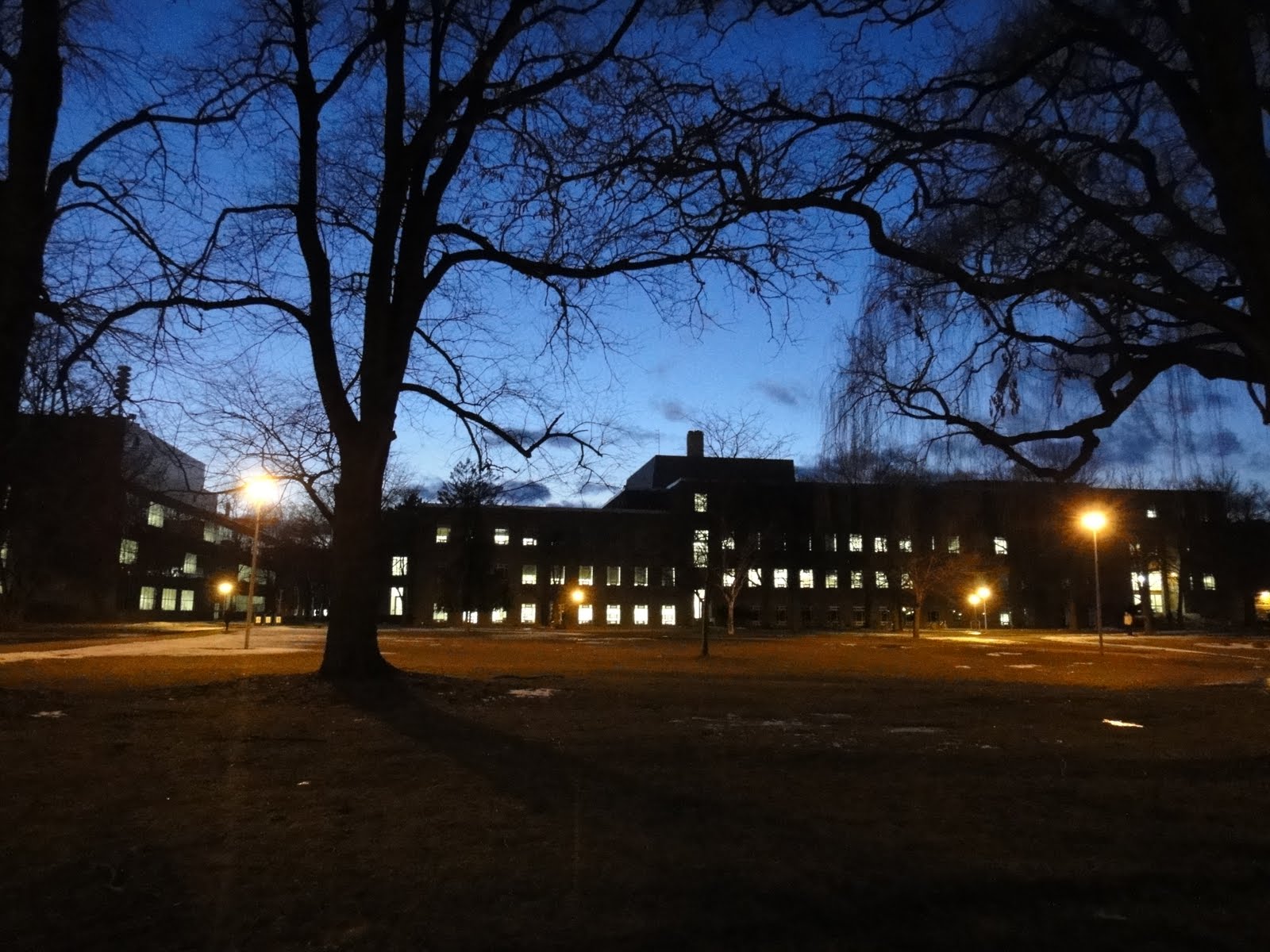
We had a bit of a thaw over a couple of days, so a lot of snow and ice melted, forming some very waterlogged ground in the green space at the centre of the campus. I became interested in the way the light was shining off the water (which was rapidly turning to ice) in the gathering darkness.
Tuesday, March 1, 2011
McMaster Ice Pond (February 28, 2011)
Some images of the campus I took last night on the way home from McMaster University. The buildings you can see are mostly Engineering-related.

We had a bit of a thaw over a couple of days, so a lot of snow and ice melted, forming some very waterlogged ground in the green space at the centre of the campus. I became interested in the way the light was shining off the water (which was rapidly turning to ice) in the gathering darkness.


We had a bit of a thaw over a couple of days, so a lot of snow and ice melted, forming some very waterlogged ground in the green space at the centre of the campus. I became interested in the way the light was shining off the water (which was rapidly turning to ice) in the gathering darkness.
Christchurch (2001, 2010)
A week ago Christchurch, New Zealand, was hit by the second massive earthquake in under six months. By now most people have had a look at the news coverage, which at this point it mostly about the rising count of the dead and the tireless efforts, both by locals and from international contributors, to sort out the mess and help people start getting on with their lives.
I'm fortunate not to have had any family or friends in Christchurch at the time of the quake. Still I'm sending out my best wishes and hopes for those who were affected by this (including friends of friends).

Above: One of Christchurch's little throwbacks to the "Old Country"--an Avon River with little boats ready for punting, close to the downtown centre.
I couldn't watch the videos, because it was like seeing my worst childhood nightmare come true. I still remember the Civil Defense pamphlets and the earthquake drills in school (get under the desk, get under the doorway). Kiwis know they walk on unstable ground--we know what we live with, but it's still a terrible shock when this happens (not for 80 years has New Zealand seen this kind of damage). I remember as a child waking in the middle of the night to the steady vibration of tremors and waiting to see if it would stop; I was lucky and it always did.

Above: Inside at the Botanical Gardens. Aside for the obvious and awful loss of human lives, I shudder to think what irreparable damage may have been done to structures like these and to the overall cultural infrastructure of the city, which will probably be the last thing to regenerate. So many historic buildings, which in New Zealand is actually a pretty rare thing in an urban area.

City centre, Cathedral Square. I expect the building you see here is no longer standing.

Above: Christchurch's iconic Cathedral in the centre of downtown. The spire at left crumbled and collapsed during the earthquake. Rescuers have been unable to enter the Cathedral so far, given the instability of the walls, but they believe about 20 people to have been inside when the spire came down. This is the most recognisable building in the city, so its collapse has a symbolic weight beyond the physical damage.

Above: A bit of a classic sight--the Wizard of New Zealand in Cathedral Square (I took this in January, 2001). He survived the earthquake and is now leaving Christchurch, since his public stage has been destroyed.

Above: Dandelion fountains near City Hall. For some reason these always remind me of my childhood in the 1980s, though I don't recall whether we had any the same in the area where I grew up. I had seen many pictures of them though, and I was pleased to take photos of my own (this was February, 2010).

Arts centre, across from the Canterbury Museum (February, 2010). Not much hope that these old buildings have survived.
I remember going into this quad to look around while waiting to meet up with a friend by the Botanical Gardens across the street. A man was letting his little son run around the place. His son, who was still quite young (under five I think), had developmental problems--possibly Down's Syndrome, I can't quite recall. We got into a discussion about politics, class, education and funding of the school system; I remember asking him about the decile rankings of schools. It was surprisingly easy conversation between two people who'd only met five minutes before. I remember thinking how much I liked the frankness and friendliness of the people and the place--not just Christchurch but the whole country--it was one small memorable moment among many in that action-packed trip, but it stood out.
I hope he and his family are OK.
I'm fortunate not to have had any family or friends in Christchurch at the time of the quake. Still I'm sending out my best wishes and hopes for those who were affected by this (including friends of friends).
Above: One of Christchurch's little throwbacks to the "Old Country"--an Avon River with little boats ready for punting, close to the downtown centre.
I couldn't watch the videos, because it was like seeing my worst childhood nightmare come true. I still remember the Civil Defense pamphlets and the earthquake drills in school (get under the desk, get under the doorway). Kiwis know they walk on unstable ground--we know what we live with, but it's still a terrible shock when this happens (not for 80 years has New Zealand seen this kind of damage). I remember as a child waking in the middle of the night to the steady vibration of tremors and waiting to see if it would stop; I was lucky and it always did.
Above: Inside at the Botanical Gardens. Aside for the obvious and awful loss of human lives, I shudder to think what irreparable damage may have been done to structures like these and to the overall cultural infrastructure of the city, which will probably be the last thing to regenerate. So many historic buildings, which in New Zealand is actually a pretty rare thing in an urban area.
City centre, Cathedral Square. I expect the building you see here is no longer standing.
Above: Christchurch's iconic Cathedral in the centre of downtown. The spire at left crumbled and collapsed during the earthquake. Rescuers have been unable to enter the Cathedral so far, given the instability of the walls, but they believe about 20 people to have been inside when the spire came down. This is the most recognisable building in the city, so its collapse has a symbolic weight beyond the physical damage.
Above: A bit of a classic sight--the Wizard of New Zealand in Cathedral Square (I took this in January, 2001). He survived the earthquake and is now leaving Christchurch, since his public stage has been destroyed.
Above: Dandelion fountains near City Hall. For some reason these always remind me of my childhood in the 1980s, though I don't recall whether we had any the same in the area where I grew up. I had seen many pictures of them though, and I was pleased to take photos of my own (this was February, 2010).
Arts centre, across from the Canterbury Museum (February, 2010). Not much hope that these old buildings have survived.
I remember going into this quad to look around while waiting to meet up with a friend by the Botanical Gardens across the street. A man was letting his little son run around the place. His son, who was still quite young (under five I think), had developmental problems--possibly Down's Syndrome, I can't quite recall. We got into a discussion about politics, class, education and funding of the school system; I remember asking him about the decile rankings of schools. It was surprisingly easy conversation between two people who'd only met five minutes before. I remember thinking how much I liked the frankness and friendliness of the people and the place--not just Christchurch but the whole country--it was one small memorable moment among many in that action-packed trip, but it stood out.
I hope he and his family are OK.
Labels:
new_zealand,
south_island
Thursday, February 24, 2011
Terry Fallis @ Ron Joyce Centre (February 24, 2011)
Today I was lucky enough to catch a talk by author and PR practitioner Terry Fallis at McMaster's Ron Joyce Centre in Burlington. Introduced by Master's of Communication Management program director Dr. Terry Flynn, Mr. Fallis discussed his experiences using social media (primarily podcasting) to find a market for his self-published first novel, "The Best Laid Plans". He also touched on the implications of social media for public relations practitioners.
Below: Preparing to speak to students of Communication Management.

Mr. Fallis won the Stephen Leacock Medal for "The Best Laid Plans" in 2008, and just last month for the same novel he also won the national "Canada Reads" contest run by the CBC. He's since had a sequel published, "The High Road".

I always enjoy taking pictures of people "performing" (to me, public speaking is always performing, just as much as acting or singing would be). Below: This particular speaker used a lot of hand gestures (as I know I do too), so I tried to capture that in the pictures. I'm not sure exactly what's being referenced in the one below, but it looks significant!

Below: a rapt audience (the rest of the class is out of view).

Below: This was one of my two favourite pictures from the talk. I love how the camera just focussed on his hand (also the microphone), I think that happened because I moved the camera and it didn't have time to re-focus on his face. A great effect though.

Below: This was my other favourite picture. I'm not quite sure why, it just has a nice feeling to it.

More hand gestures--I had quite a few more shots like that, they turned out surprisingly well. I decided not to go overboard and post a whole slew of them here. Taking photos like these reminds me of the 30-second gesture drawings we used to do as warm-ups in figure-drawing class at NSCAD. The photos turn out like those drawings did: many of them slightly "off", some that look pretty good, and maybe a few that "catch" something really interesting.
Below: Preparing to speak to students of Communication Management.
Mr. Fallis won the Stephen Leacock Medal for "The Best Laid Plans" in 2008, and just last month for the same novel he also won the national "Canada Reads" contest run by the CBC. He's since had a sequel published, "The High Road".
I always enjoy taking pictures of people "performing" (to me, public speaking is always performing, just as much as acting or singing would be). Below: This particular speaker used a lot of hand gestures (as I know I do too), so I tried to capture that in the pictures. I'm not sure exactly what's being referenced in the one below, but it looks significant!
Below: a rapt audience (the rest of the class is out of view).
Below: This was one of my two favourite pictures from the talk. I love how the camera just focussed on his hand (also the microphone), I think that happened because I moved the camera and it didn't have time to re-focus on his face. A great effect though.
Below: This was my other favourite picture. I'm not quite sure why, it just has a nice feeling to it.
More hand gestures--I had quite a few more shots like that, they turned out surprisingly well. I decided not to go overboard and post a whole slew of them here. Taking photos like these reminds me of the 30-second gesture drawings we used to do as warm-ups in figure-drawing class at NSCAD. The photos turn out like those drawings did: many of them slightly "off", some that look pretty good, and maybe a few that "catch" something really interesting.
Labels:
communication,
events,
Liberals,
literary,
mcmaster
Wednesday, February 23, 2011
Feet (Part 1) 2000-2010
By the river. Ottawa, Ontario. April 2000. I went to visit Ottawa for the first time, with my friend Lucas from Halifax, and took this picture as we were sitting by the bridge closest to Parliament Hill. It's the first picture I can find that involves my feet, and I think I took it because we were having short rest/observation stop and I was fiddling with my camera. Those sneakers were always incredibly bouncy, due to their thick soles.

Zines. Hamilton, Ontario. March 31st, 2003. My mother gave me those sheepskin slippers which were from New Zealand; I wore them until they couldn't really be worn any more. Spread out in front of me are zine-making materials. This was the last zine I made before going back to university (McMaster) in May 2003. The spray bottle of water in the left upper corner was a tool to keep the cat from rolling around on my project-in-progress ("cat discipline").

Highway to Guelph. Ontario. May, 2005. Just a spring airing, a country drive with D.D. though I'd never visited Guelph before so I was quite interested to see the place.
Cooling off. Lake Tekapo, Mackenzie Country. New Zealand. February 4th, 2010. We (our Stray bus) visited this lake on the way up to Christchurch, to take a look at the Church of the Good Shepherd which is perched iconically on the shore. I waded into the clear, cold water and watched some ducks gliding past a little way off, oblivious to my presence. It was completely peaceful in spite of the tourists milling around the church behind me.
Longitude zero (Greenwich Meridian). Royal Observatory, Greenwich, England. March 15, 2008. Here I am standing with, literally, one foot in the eastern hemisphere and one foot in the western one. It's hard not to be struck by the arbitrariness of the line, which, though so solid looking, has actually been moved about quite a bit over time. History is a funny thing.
Labels:
feet,
selfportrait
Saturday, February 19, 2011
Thursday, February 17, 2011
Grass Shadow (May 25, 2010)
I like pictures that disorient.
This one is tricky to untangle, but as the one who took the picture, I get the pleasure of revealing the answer to a bit of a visual riddle. The photo was taken at Eglinton West subway station in Toronto, which has glass walls along the platform. I think it was later in the afternoon, and the sun was slanting at an angle that cast the plants' shadows against the glass. It's an unusual visual effect, probably because you can see both the shadows and the plants themselves behind them, and there is a thin layer of dust on the outside of the glass that is lit up by the sun, creating extra contrast.*
The ghosts of grasses.
*The "look" in this picture always reminds me of the video for "Go!" by Lemon Jelly.
Labels:
plants silhouette sunlight
Wednesday, February 2, 2011
Snowpocalypse (February 1, 2010)
For those who were bundled up inside last night, toasting their toes by a fire or a heating vent, you'll be pleased to note that I was in fact outside with a waterproof camera, taking pictures of the nasty snowstorm that hit sometime after 9pm.
We all knew it was coming of course, thanks to many media warnings; so most people were tucked away safely by the time the snow actually arrived. I, on the other hand, had been hanging out at a friend's place until about 10:45 PM; by the time I got outside the snow and wind had picked up, making things less than pleasant for my trip home by public transportation. The upside was the pictures, which turned out quite nicely given that I wasn't willing to go out of my way to capture any special effects or locations.

10:47 PM: Queen at George Street between King West & Main West, looking east towards Hess Street.

Queen Street north of Main West, looking towards King West: The castle-like structure seen through the trees is the Scottish Rite building.

Streetlamp on Queen Street, north of Main Street West.

Main Street West at the corner of Queen South: GO buses and city buses (Hamilton Street Railway) kept running, thankfully; it didn't take me too long to get home.

Queen Street South at Main, facing Southwest: A strong wind was whipping up the hill here. I was glad I'd bothered to bring a hat.

10:53 PM: Waiting for the bus on Main Street West at Hess; south side, looking West.

11:11 PM: Main East at Emerald, south side facing west. The wind was whipping eddies of powdery snow across the ground--like water across a river bed, or sand in a desert storm--which were illuminated in this picture by the car headlights.

Parking lot, Emerald Street at Main East: walking towards the alley, the sky's lit up by lights bouncing off the clouds and the flying snow. Cloudy, snowy nights in the city are always eerily bright in this way, as the electric glow of human activity is amplified umpteen thousand times in miniature by whirling airborne reflective flakes.
We all knew it was coming of course, thanks to many media warnings; so most people were tucked away safely by the time the snow actually arrived. I, on the other hand, had been hanging out at a friend's place until about 10:45 PM; by the time I got outside the snow and wind had picked up, making things less than pleasant for my trip home by public transportation. The upside was the pictures, which turned out quite nicely given that I wasn't willing to go out of my way to capture any special effects or locations.
10:47 PM: Queen at George Street between King West & Main West, looking east towards Hess Street.
Queen Street north of Main West, looking towards King West: The castle-like structure seen through the trees is the Scottish Rite building.
Streetlamp on Queen Street, north of Main Street West.
Main Street West at the corner of Queen South: GO buses and city buses (Hamilton Street Railway) kept running, thankfully; it didn't take me too long to get home.
Queen Street South at Main, facing Southwest: A strong wind was whipping up the hill here. I was glad I'd bothered to bring a hat.
10:53 PM: Waiting for the bus on Main Street West at Hess; south side, looking West.
11:11 PM: Main East at Emerald, south side facing west. The wind was whipping eddies of powdery snow across the ground--like water across a river bed, or sand in a desert storm--which were illuminated in this picture by the car headlights.
Parking lot, Emerald Street at Main East: walking towards the alley, the sky's lit up by lights bouncing off the clouds and the flying snow. Cloudy, snowy nights in the city are always eerily bright in this way, as the electric glow of human activity is amplified umpteen thousand times in miniature by whirling airborne reflective flakes.
Saturday, January 8, 2011
Because We Like It (April, 2000)
The pictures below are from a Concordia Fine Arts year-end off-campus Ceramics show, "C'est Rare, Cerart". The piece is called "Because We Like It", and it's a collaboration between me and my friend Garnet Muething.
Above: The "lichens" look like they've been glazed with Cranberry Rust, and the bowl at left was glazed with a layer of matte white with the rim dipped in Cranberry Rust.
The "collaboration" was not a strictly pre-planned one. Garnet and I had met and become friends because we were both take ceramics courses; she was a level ahead of me, and thus had more technical privileges (such as being allowed to make her own glazes). So at some point she offered to split a batch of porcelain with me, and so I got my first opportunity to work with something other than stoneware or earthenware. Garnet was using a special stoneware recipe as well as making her own porcelain.
Above: The lichens have been dunked in a grey-"hazel" glaze made by Garnet, possible with rims in Cranberry Rust. The bowl on the left was glazed matte white and the rim was dipped in "Raisin", a dark bluish-purple glaze made by our co-student Geneviève. It was part of the Cone 11 firing, hence the extreme effects.
We ended up making the clay, bisque firing our porcelain pieces, and then using the same glazes together (several of which were glazes Garnet had made), so although our pieces were for two separate projects, we eventually got the idea of combining them into a third different project and proposing it for the year-end exhibition. These pictures show parts of what we came up with, which we called "Because We Like It". I liked Garnet's project names--she had another one called "You Know You Want To", as I recall.
These lichens were dipped in matte white and then Cranberry Rust; the bowl is a Celadon, oxidation-fired (hence yellow, not green).
All my bowls and (I think) all Garnet's lichens--the name she gave to the little tube-like, organic-looking sculptures--were made with "sculpture" porcelain. We made this in large batches and stored it in our lockers until it ran out and a new batch had to be made. There's a long story here about me accidentally discovering that porcelain improves with fermentation (something the ancient Chinese already knew), but I'll save it for another blog post ;-)
Above: A Hazel bowl with clear blue inside. fired to Cone 9; Garnet's lichens are Hazel, possibly dipped with Cranberry Rust rims.
Porcelain is a clay that can be fired to very high temperatures without melting (though it does "vitrify"). So the glazes we used were for high-firing, and the highest temperature we were permitted to fire to was Cone 9, around 1,280 degrees C (pyrometric cones, designed to melt at certain temperatures, are placed inside the kiln and used to determine when the correct firing temperature has been reached).
Glazes when fired to high temperatures "behave" in a much less stable way than when fired to a lower level. This means that glaze effects are much more difficult to predict than they would be at a lower cone (04, for example, is a low firing temperature appropriate for terra-cotta, around 1,060 degrees C.). It's also harder to achieve "warm" colours (red, yellow, orange) at high temperatures, and to produce "bright" colours in general. That's why the brightly-coloured pottery you see in many stores is likely to be less durable--because it probably wasn't fired to a high temperature.
A nice view of my best "exploding star effect" bowl (Cone 11 firing). The lichens have Cranberry Rust (red ones on the right) and the Hazel/clear blue combo (at left).
Ceramic pieces are usually fired twice when they're glazed, as I explained in this post. After these pieces went through the bisque firing, they were dunked in one or more liquid glazes--many of the interesting effects come from combinations of glazes rather than one glaze on its own (though there can be considerable variation even with one glaze, especially in a reduction firing).
One of the glaze firings went over-temperature by what looked like at least a full cone, but since the third cone was almost fully melted I assumed the firing had reached the equivalent of Cone 11, about 1,315 degrees C. (insert Spinal Tap jokes here). Fortunately for Garnet, none of her work was in that firing. I'll never forget the process of unloading the kiln, during which I learned a new French swearword (uttered by one of the other students when he saw the mess-!). The glazes had run all over the kiln shelves and in spite of kiln-wash, a lot of the pieces had fused themselves to the shelves, which of course had to be cleaned.
Yet from this spectacular screw-up came some of my most interesting and beautiful pieces, which I never would have achieved otherwise since the temperature limit was technically Cone 9. Because the glazes over-melted, they ran together/blended in unique ways according to the types of glazes and the shapes of the bowls to which they'd been applied. And in spite of my sloppy throwing technique, none of my bowls collapsed from the heat.
All three bowls visible in the picture above came out of the Cone 11 firing. At the back, the blue bowl was dunked first in matte white then edged with a clear dark blue glaze. The middle bowl was matte white with a Cranberry Rust rim (compare it to the other one above, with the same glaze combo; which was fired to regular Cone 9. Quite the contrast!). At the front is a bowl dipped in Garnet's Hazel glaze, edged with what could be Geneviève's Raisin or Cranberry Rust (again, it's hard to tell). The lichens in the centre are all fired to Cone 9 with Cranberry Rust; those at left were Hazel with dark clear blue.
That white/orange "starburst" bowl, one of the best from the firing, had attached itself solidly to the kiln shelf; I remember feeling afraid that I'd lose it (i.e. it would have to be broken off the shelf in chunks). Then a fellow student took the shelf, put her foot on it, grabbed the bowl and yanked it off in one piece--taking a chunk of kiln-shelf with it! I had to use a grinding wheel on it for about half an hour before the bottom of the bowl was flat again. Good times.
Tuesday, January 4, 2011
Development! 2: Commute (February 2007)
For twelve months during my Master's degree, I commuted from Hamilton to North York, in the Greater Toronto Area (GTA). I took the #47 Go bus which travels along the "express" highway, 407. During the same period I also bought my first digital camera, and the many hours I spent rolling along through this landscape were just as often employed in photographing as they were in chewing through my course readings in linguistics.
The day I took these pictures, it looks like I took the 11AM bus from the Hamilton GO Station scheduled to arrive at York around 12:45PM, probably for a class at 1:30PM.

11:36AM: Carpool lot, Burlington, near Highway 407 & Dundas.
The pictures I took during this time were grouped in my mind with another set of images taken several years earlier, which I'd called "Development!"--they were taken in housing developments around the Hamilton/Burlington/Oakville area. I'm both fascinated and repulsed by what I call "cookie-cutter housing"; these kinds of buildings were the impetus for the original "Development!" project. The contemporary "row-houses" seen in the picture above lack all the charm of their distant ancestors in the city of London, England (for example). Somehow I doubt that in 100 years they'll have become any more appealing; in fact given the low quality of construction, they probably won't even be standing.

11:37AM: Carpool lot, Burlington.
This lot is the first of three we at which the bus stops. The second one is at Highway 407 and Bronte Road, and the last one is by 407 and Trafalgar Road in Oakville. I always found these lots very isolated, oddly located (for the convenience of the highway and the bus, not of travellers) and quite lonely-looking. I often saw people waiting late at night in the cold, and thought I'd prefer not to be in that situation.

11:54AM: Heading east, Highway 403, bound for Square One in Mississauga.
This is a detour that makes up for about 20 minutes of the bus route. And Square One is a strange outpost, like an groundlocked spaceport in a bad sci-fi movie, a cluster of faux-futuristic towers housing goodness knows what--perhaps the ubiquitous superficially lavish condos or office space well under the Toronto Downtown price--dotted around the large mall that doubles as a transit terminal.

12:11PM: Towards Bramalea.
My impressions at the time: "Canada—in some ways only this part of it, but to me, every part of it—is an amplified landscape: everything built bigger, split apart, fragmented and not made for human feet to traverse—now I know that part is Southern Ontario specifically, this GTA area as the real example. Southern Ontario’s sprawl. Highways, office towers, endless rows of identical houses separated by grassy spaces that hold massive pylons. It all marches off towards the horizon. And it all repeats, with the systematicity of technological reproduction."

12:12PM: I think this is the turning onto Dixie Road at the 407.

12:13PM: Another shot from the same position. Something dusty blue yet crisp about the light on super-cold days like this one, which was probably why I was taking so many pictures.
The day I took these pictures, it looks like I took the 11AM bus from the Hamilton GO Station scheduled to arrive at York around 12:45PM, probably for a class at 1:30PM.
11:36AM: Carpool lot, Burlington, near Highway 407 & Dundas.
The pictures I took during this time were grouped in my mind with another set of images taken several years earlier, which I'd called "Development!"--they were taken in housing developments around the Hamilton/Burlington/Oakville area. I'm both fascinated and repulsed by what I call "cookie-cutter housing"; these kinds of buildings were the impetus for the original "Development!" project. The contemporary "row-houses" seen in the picture above lack all the charm of their distant ancestors in the city of London, England (for example). Somehow I doubt that in 100 years they'll have become any more appealing; in fact given the low quality of construction, they probably won't even be standing.
11:37AM: Carpool lot, Burlington.
This lot is the first of three we at which the bus stops. The second one is at Highway 407 and Bronte Road, and the last one is by 407 and Trafalgar Road in Oakville. I always found these lots very isolated, oddly located (for the convenience of the highway and the bus, not of travellers) and quite lonely-looking. I often saw people waiting late at night in the cold, and thought I'd prefer not to be in that situation.
11:54AM: Heading east, Highway 403, bound for Square One in Mississauga.
This is a detour that makes up for about 20 minutes of the bus route. And Square One is a strange outpost, like an groundlocked spaceport in a bad sci-fi movie, a cluster of faux-futuristic towers housing goodness knows what--perhaps the ubiquitous superficially lavish condos or office space well under the Toronto Downtown price--dotted around the large mall that doubles as a transit terminal.
12:11PM: Towards Bramalea.
My impressions at the time: "Canada—in some ways only this part of it, but to me, every part of it—is an amplified landscape: everything built bigger, split apart, fragmented and not made for human feet to traverse—now I know that part is Southern Ontario specifically, this GTA area as the real example. Southern Ontario’s sprawl. Highways, office towers, endless rows of identical houses separated by grassy spaces that hold massive pylons. It all marches off towards the horizon. And it all repeats, with the systematicity of technological reproduction."
12:12PM: I think this is the turning onto Dixie Road at the 407.
That sense of "amplification" that I wrote about at the time, during the trips I took, came from the impression of space taken for granted, assumed to continue without obstacle. It makes me think now of the differences between cities built on islands and peninsulas, and those like Toronto, Los Angeles, Atlanta, even London--that just keep expanding like little universes.
12:13PM: Another shot from the same position. Something dusty blue yet crisp about the light on super-cold days like this one, which was probably why I was taking so many pictures.
I've written here before about the contrast between the physical spaces of habitation in which I've spent my life--how when it was new to me, Canada was a simple hugeness, an incomprehensibly exaggerated version of what I had known previously. Even now, that early dim formation stays with me as a kind of rough schema that's been much worked-over and complicated over time, like an evolving collage of experiences and memories. The cities and highways are only a small part of that, but the impression is one of weird extremes of quirkiness and sameness.
Sometimes on this bus ride, which I now make once or twice a week, I think about the space taken up by highways and roads and the way that space is in some sense nullified by its purpose, as space to be crossed only--or to be used for traversing space itself--not to be dwelt on or dallied in. There's no attempt to integrate these roads into a living space. In fact it's more the opposite--they are designed to segregate and to aid segregation (something I mentioned here as well), pushed out as far as possible from the places where people make their homes, ironically used as conduits for the passage to sub-/ex-urban retreat.
Labels:
development,
ontario,
roads,
toronto,
transit
Subscribe to:
Posts (Atom)
